
Layoffs Create a Transition Phase Most Organizations Don’t Manage
Why what follows the announcement determines long-term outcomes

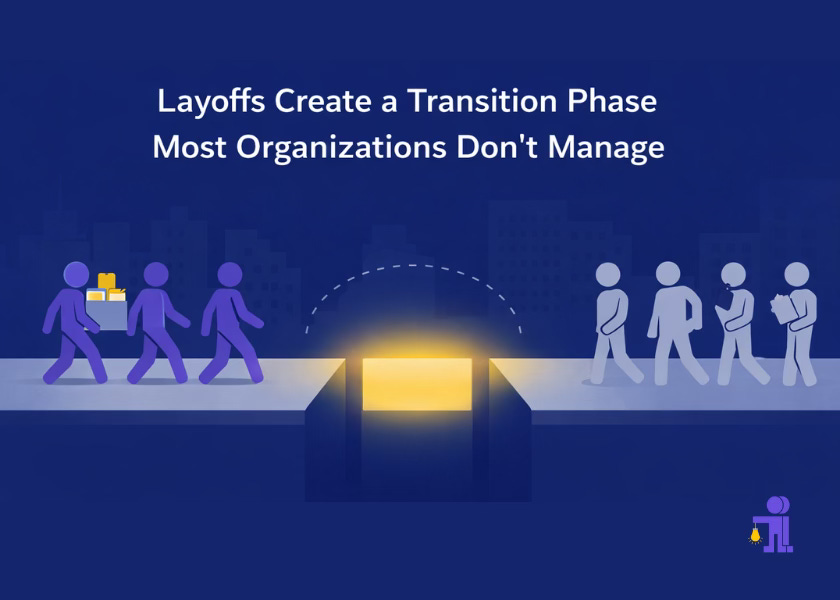
Most organizations treat a layoff as a moment in time: a date on the calendar, a message to prepare, a meeting to survive. Once the announcement is made and severance details are shared, leadership often assumes the hardest part is over.
It isn’t.
The layoff is not the event. It’s the starting point of a long, unstable middle—a transition phase that rarely has a name, a plan, or an owner.
In the weeks and months that follow, people are expected to “move forward” without clarity about what they’re moving toward. Teams are asked to refocus while roles remain undefined. Managers are told to stabilize morale while processing their own uncertainty. Leaders turn their attention to what’s next, assuming the organization will follow.
What actually follows is something else entirely.
After a layoff, time behaves differently. Decisions slow down. Trust becomes conditional. People stop volunteering information. Risk tolerance narrows. Productivity may hold—for a while—but it’s driven by vigilance, not confidence. Employees aren’t disengaged yet. They’re watching.
This is the part most organizations underestimate: the psychological middle between it happened and we’ve recovered.
For those who remain, the question isn’t What’s my job now? It’s Am I safe here—and for how long? That question quietly reshapes behavior. People hedge. They document more. They stop raising concerns that could make them visible in the wrong way. They do their work, but they stop investing in the organization as a long-term system.
From the outside, this period can look deceptively calm. Headcount has stabilized. Projects are moving. No one is openly revolting. But underneath, the organization is recalibrating around fear, not strategy.
Leaders often try to solve this phase with communication volume—more updates, more reassurance, more emphasis on resilience and focus. But reassurance without clarity doesn’t land. And communication that skips over uncertainty doesn’t reduce it; it relocates it.
What people are trying to understand in this period after the announcement is not the past decision. It’s the future logic.
At this point, leaders often push back with a familiar concern: We can’t be transparent—much of this information is confidential.
That’s true. But confidentiality is not the same thing as opacity.
People aren’t asking for details they know you can’t share. They’re trying to understand how decisions are being made now, what variables matter, and what signals to pay attention to going forward. When that logic is absent, silence fills the gap—and not in your favor.
When these questions go unanswered, people answer them themselves. Not loudly. Not all at once. But through small shifts that compound over time.
This is why organizations often experience a second wave of impact months later: unexpected attrition, stalled initiatives, brittle culture, leaders frustrated that engagement never fully rebounds. The layoff is blamed. But the real cost accumulated in the space afterward, when no one slowed down enough to acknowledge what had changed.
The long in-between is uncomfortable because it resists clean solutions. There’s no checklist for it. No single message that resolves it. And it can’t be rushed without consequences.
What Actually Helps in the Post-Layoff Transition
Organizations don’t need more messaging in this phase. They need steadiness.
That often looks like leaders being explicit about what is known, what is still evolving, and what tradeoffs are guiding decisions now—even when the answers are incomplete. It looks like giving managers language that doesn’t require false certainty. It looks like acknowledging that people are recalibrating, not resisting.
Most importantly, it means treating the period after a layoff as a transition that needs stewardship, not something to power through quietly.
Layoffs create a before and an after. But it’s the months that follow—the unstructured, emotionally charged, operationally fragile months—that determine whether an organization regains its footing or quietly fractures.
Most leadership teams plan extensively for the announcement. Very few plan for what comes next.
That gap is where long-term damage—or long-term credibility—is decided.